




Yesterday, 07:12 AM
Dr. Carol Byrne: A Series on the History of the Dialogue Mass
Fr. Cardijn & ‘Catholic Communism’
[Taken from here - emphasis The Catacombs]
In 1925, Fr. Joseph Cardijn founded an organization in Belgium known by its French title as the Jeunesse Ouvrière Chrétienne (JOC) – in English as the Young Christian Workers (YCW). As we shall see, it turned out to be a reincarnation of the original Sillon in a more openly Marxist guise. He publicly acknowledged the influence of the Sillon on the birth of his organization in a speech welcoming Sangnier to Brussels in 1921.1
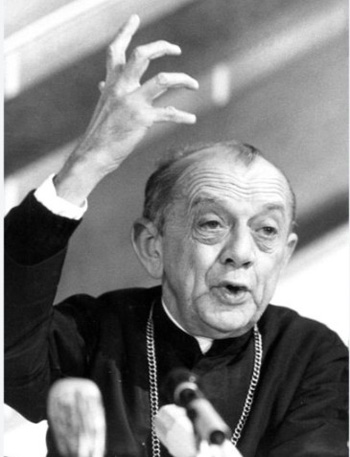
‘No one should be surprised if we mention Marx in connection with Cardijn’
A little-known fact is that many ex-Sillonists were known to have jumped ship around the time when their organization was suppressed, and they transferred their revolutionary ideals, popularly touted as “Christian Democracy,” to other organizations,2 including the YCW. Notable personalities who fitted this description were Fr. Georges Guérin, founder-chaplain of the YCW in France, and the French layman, Peter Maurin, co-founder of the Catholic Worker Movement in the USA.
A disturbing feature about Fr. Cardijn was that he ignored Pius X’s strictures on clerical political activity and devoted all his energies to political advocacy instead of a total commitment to the duties of his sacred ministry. Among those who observed this trait was a friend and admirer of Cardijn, the radical revolutionary, Dom Hélder Câmara, who stated in a personal tribute to the YCW founder:
Quote:“Seeing him and hearing him, you were left with the enduring impression of a man whose whole reason for living was the YCW. Morning, afternoon, evening, talking, chatting, travelling, awake or asleep, his thoughts were on young workers.”3
As Pius X had warned, in situations like this, God is inevitably relegated to the background, while the Gospel becomes an instrument in the service of a human ideology.
As for the YCW itself, its title holds a pertinent clue as to its hybrid and self-contradictory nature – it was a Catholic organization that sprang from the roots of Marxism. This was self-evident to those who were acquainted with its founder. Dom Hélder Câmara commented that “No one should be surprised if we mention Marx in connection with the biography of Cardijn.”4
During his time as a political prisoner in the First World War, Fr. Cardijn had read and inwardly digested Karl Marx’s Das Kapital. Inspired by its contents, he immediately drew up a draft of what would later become his Manual of the Young Christian Workers, the first edition of which was published in 1925 when the Movement was launched. It was the very embodiment of what Leo XIII had called “the craving to reconcile the maxims of the Gospel with those of the Revolution.” (Custodi di quella fede, § 15, 1892)
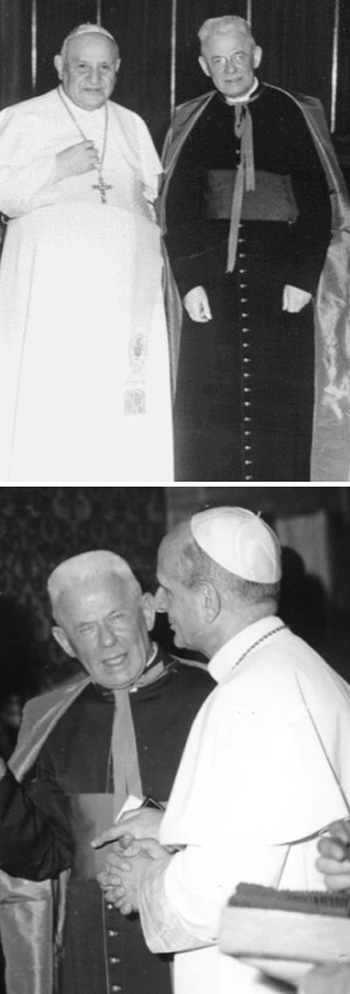
Fr. Cardijn enjoyed the warm support of John XXIII & Paul VI, who made him a Cardinal
A typical example can be found in Cardijn’s Address at the Young Christian Workers International Conference, Brussels, 1950, entitled “The Hour of the Working Class in the World Revolution.” On that occasion, he displayed his power as a demagogue to the maximum.
Addressing thousands of young workers, he adopted elements of Marxist analysis in his critique of the prevailing socio-economic situation of the workers – the imbalance of power and wealth, workers having to sell their labor for a wage “under the capitalist regime,” the consequent “exploitation” of the poor for the benefit of the few, the necessity for a united worldwide revolution of the working class to achieve their liberation. Cardijn described the working class as the “pivot,” or “the central phenomenon of what is justly [sic] termed the World Revolution of our time.”
All of these points are elements of classic Marxist theory. Marx argued that the workers must become aware of their unity as a class with shared economic and political interests, and of their strength in numbers so that, through solidarity they can achieve their aims.
As was made clear when Cardijn composed his Manual, his intention was to organize a militant campaign on an international scale based on a propaganda offensive euphemistically styled “popular education.” The underlying message was exactly that of Karl Marx: “Workers of the world, unite!” – as Cardijn himself acknowledged with pride and satisfaction in his 1950 Address.
Nor can he be exonerated on the grounds that he was calling for workers of the world to unite in the Mystical Body of Christ: There can be no concord between Christianity and Marxism in any form. For those who followed this revolutionary praxis, it was inevitable that it would lead to a replacement of Gospel values by Marxist ideas of class struggle and social justice, in other words, the politicization of the Faith.
Instead of promoting the unity and charity that Our Lord demanded, Cardijn’s revolutionary rhetoric had the effect of inciting adversarial relationships between social classes by whipping up resentment among the workers who saw themselves as victims of oppression.
There is, thus, nothing Christian in his vision for the progress of “Social Justice.” It was just a tactical position designed to achieve a political rather than a supernatural end, akin to Marc Sangnier’s dream for the future Democracy which Pius X denounced in his Letter to the Sillon as a “blasphemous comparison between the Gospel and the Revolution.”
To be continued
1.Joseph Cardijn, ‘Welcome Speech to Marc Sangnier, Founder of the Sillon Movement’, February 5, 1921, Fonds Cardijn, General Archives of Belgium, Brussels, published on the Cardijn Digital Archive.
2. Examples are the scouting and youth hostel associations, the Peace Movement, Pius XI’s Specialized Catholic Action, the Christian Trade Unions, the Popular Democratic Party and the Popular Republican Party.
3. Hélder Câmara, ‘Préface’, in Marguerite Fiévez and Jacques Meert (eds.), Cardijn, Brussels, EVO, 1969, p. 7.
4. Ibid.
"So let us be confident, let us not be unprepared, let us not be outflanked, let us be wise, vigilant, fighting against those who are trying to tear the faith out of our souls and morality out of our hearts, so that we may remain Catholics, remain united to the Blessed Virgin Mary, remain united to the Roman Catholic Church, remain faithful children of the Church."- Abp. Lefebvre